易Mantic arts dossier · Yijing-derived and correlative systems
扬雄《太玄》
Yáng Xióng Tàixuán·Yang Xiong's Canon of Supreme Mystery
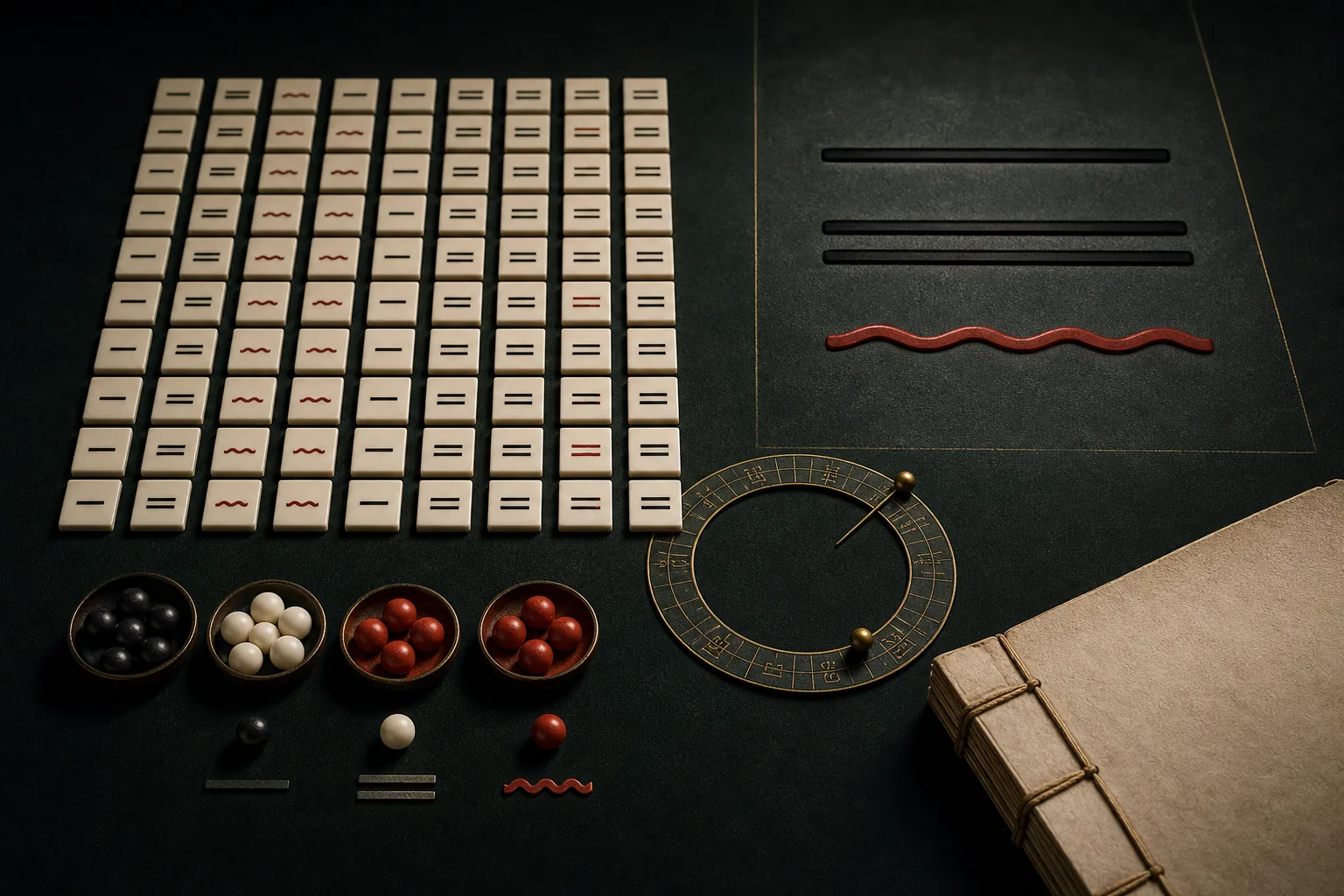
Yang Xiong's ternary symbolic cosmology of eighty-one tetragrams and 729 appraisals, coordinated with calendar, seasons and phases: modeled on the Changes yet independent.
- Aliases
- Taixuan, Canon of Supreme Mystery
- Formation
- Late Western Han
- Evidence status
01Core principles
Core principles
Translate formulas into structure: what enters, how the model is arranged, and which relations drive interpretation.
Each line has three states; four lines yield eighty-one tetragrams, with nine appraisals describing positions within each. The system also coordinates regions, calendrical degrees and the five phases.
Key concepts
- ternary signs
- eighty-one tetragrams
- nine appraisals
02Origins and historical development
Origins and historical development
Keep traditional accounts, surviving evidence and later transformations distinct.
Composed at the end of the Western Han, the Taixuan received commentaries by figures including Fan Wang and Sima Guang and has remained at the intersection of philosophy, calendar, literature and divination.
03Evidence limits and research debates
Evidence limits and research debates
Mystery belongs to the unknown—not to presenting uncertainty as fact.
The Taixuan is neither an ordinary sixty-four-hexagram method nor a set of modern fate-calculation formulas.
This dossier supports historical, textual and methodological study. Internal traditional explanations are not modern empirical validation and do not replace medical, legal, financial or other professional advice.
04Core texts and materials
Core texts and materials
- 01Taixuan
- 02Book of Han, Biography of Yang Xiong
- 03Commentaries by Fan Wang, Sima Guang and others